


HP MJF 3D Printing
Utilizing HP MJF 3D Printing technology for low-volume serial production, we deliver isotropic nylon parts with high mechanical strength and fine detail without support structures.
Upload your CAD files and receive a custom quote within 2 hours.
Your uploads are confidential and secure.
What is HP MJF 3D Printing?
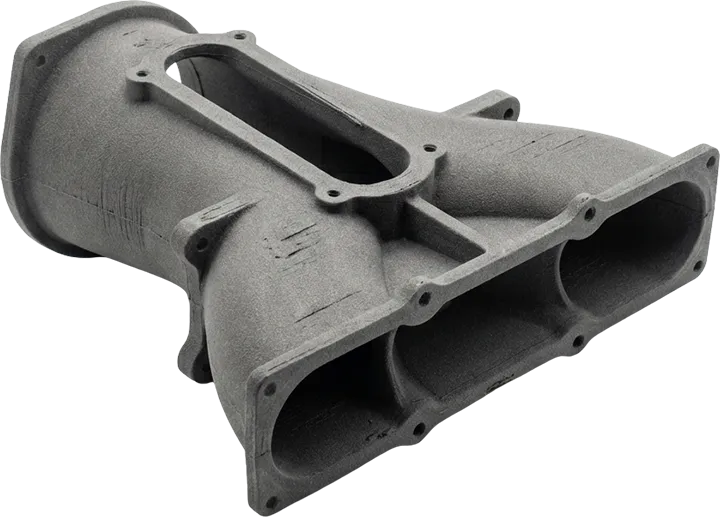
HP Multi Jet Fusion (MJF) is a groundbreaking technology that takes speed and part density to the next level in powder-based additive manufacturing. Similar to SLS, it uses Nylon PA12 powder but utilizes fusing agents and heating lamps instead of lasers to bind the material. This process enables the production of watertight parts with nearly 100% density at mass-production speeds. ProtoDep’s MJF service is the ideal solution for low-volume production (50-500 units), allowing you to obtain isotropic, durable parts without the high cost of traditional tooling.
Advantages of MJF Printing
Faster Lead Times: Significantly faster production cycles compared to SLS.
High Performance: Nearly 100% density and isotropic mechanical strength (consistent strength in X, Y, and Z axes).
Watertight & Airtight: Superior sealing properties for manifolds and fluid tanks.
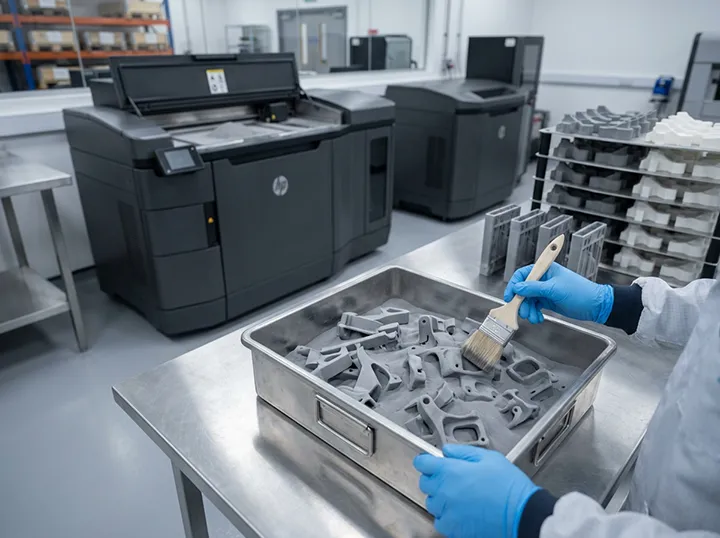
Design Freedom: No support structures required, allowing for complex geometries and nested parts.
Limitations of MJF Printing
Default Color: Parts come out naturally gray (typically dyed black for a finished look).
Surface Texture: Matte and slightly grainy surface finish (can be improved with post-processing).
Fine Details: While precise, it is not as sharp for micro-details as SLA resin printing.
MJF Production Specifications
Metric Values
Maximum Build Volume
380 x 284 x 380 mm
Standard Tolerance
±0.2 mm
Layer Thickness
80 mikron
Min. Wall Thickness
0.8 mm
MJF Printing Material Options
The ProtoDep MJF library focuses on industrial-grade Nylon (PA12, PA11) powders. Offering isotropic mechanical properties, these materials deliver results closest to injection molding quality for everything from functional prototypes to end-use parts requiring high chemical resistance.
Top Industries for MJF 3D Printing

Industrial Machinery and Robotics
MJF provides the high mechanical strength required for robotic grippers, fixtures, and specialized apparatus used in factory automation. These lightweight parts serve as professional metal replacements, significantly increasing production line efficiency and offering long-term durability against friction and wear.
Learn More
Automotive and Mobility
MJF technology plays a critical role in producing parts that require watertightness, such as fuel and air ducts. Thanks to its resistance to high temperatures and vibrations, it offers reliable solutions for both functional testing and under-the-hood end-use parts, such as electrical connectors.
Learn More
Medical and Healthcare Technologies
With certified biocompatible materials suitable for skin contact, MJF has become a standard for producing custom orthotics and prosthetics. It provides a reliable infrastructure for manufacturing complex surgical guides and lightweight medical device housings that are sterilizable.
Learn More
Consumer Electronics
Ideal for electronic device enclosures and wearable technology products with complex assembly details. MJF meets your low-volume serial production needs without expensive tooling costs, offering high strength in thin-walled designs and flexible snap-fits.
Learn MoreMJF 3D Printing Design Guide
1. What is the minimum wall thickness for MJF 3D printing?
For successful industrial MJF production, the minimum wall thickness should be 0.8 mm. However, for optimal structural integrity and durability, a design value of 2 mm or more is recommended. Extremely thin walls carry a risk of deformation during the post-printing cooling process.
2. How can I hollow out parts and add escape holes to reduce MJF costs?
Hollowing out thick parts is an effective method for cost saving. To ensure the trapped powder can be removed, you must include at least two escape holes with a minimum diameter of 2-3 mm in your design.
3. Why doesn’t HP MJF technology require support structures?
MJF is a powder bed technology where the unsintered powder acts as a natural support for the part during printing. This “Design Freedom” allows for the production of complex geometries and internal channels that would be impossible to manufacture with traditional methods or FDM.
4. What is the recommended clearance for interlocking or moving parts in MJF?
For print-in-place moving mechanisms, a minimum clearance of 0.5 mm is recommended to prevent parts from fusing together. In highly complex assemblies, confirming this value with our engineers will minimize the risk of error.
5. How can I prevent warping on large, flat surfaces in MJF printing?
Large, thin, flat plates are prone to warping due to thermal stress. To minimize this risk, structural ribs should be added to wide surfaces, or the design should be lightweighted using lattice structures.
6. Are MJF 3D printed parts watertight and airtight?
Yes. Parts printed with HP MJF technology using Nylon PA12 possess natural watertight and airtight properties due to their high part density. This makes MJF ideal for fluid manifolds and pressure tanks.
7. What is the fundamental difference between MJF and SLS technology?
While SLS uses a laser beam to fuse powder, MJF utilizes fusing agents and heating lamps. MJF offers faster production cycles and more consistent isotropic mechanical properties compared to SLS. Additionally, MJF surfaces are generally smoother and more uniform.
Quote in Seconds, Parts in Days
Upload your 3D CAD files, select your manufacturing technology, and receive an instant cost analysis. Zero wait time, no minimum order requirements.