


What Is SLA and DLP 3D Printing? Working Principle, Advantages, and Comparison

Introduction
Resin-based 3D printing technologies have become indispensable for professionals seeking high resolution and exceptional surface quality in the world of additive manufacturing. SLA (Stereolithography) and DLP (Digital Light Processing) technologies offer the ability to produce parts with detail levels that FDM printing cannot achieve, particularly standing out in jewelry, dentistry, medical modeling, and precision prototyping applications.
In this comprehensive guide, we will examine in detail everything you need to know about SLA and DLP technologies, from working principles to material options, from advantages and disadvantages to application areas. Whether you are an engineer looking to produce high-precision parts for industrial applications or an entrepreneur wanting to make the right decision in technology selection, this article will provide you with a clear perspective.
What is SLA 3D Printing?
SLA (Stereolithography) is the oldest and most mature of 3D printing technologies. Developed by Chuck Hull in 1986, this method creates objects layer by layer using liquid photopolymer resins that cure with UV light.
Basic Working Principle of SLA
SLA technology works on the principle of a precise laser beam scanning the liquid resin surface and curing selected areas. Here are the basic steps:
-

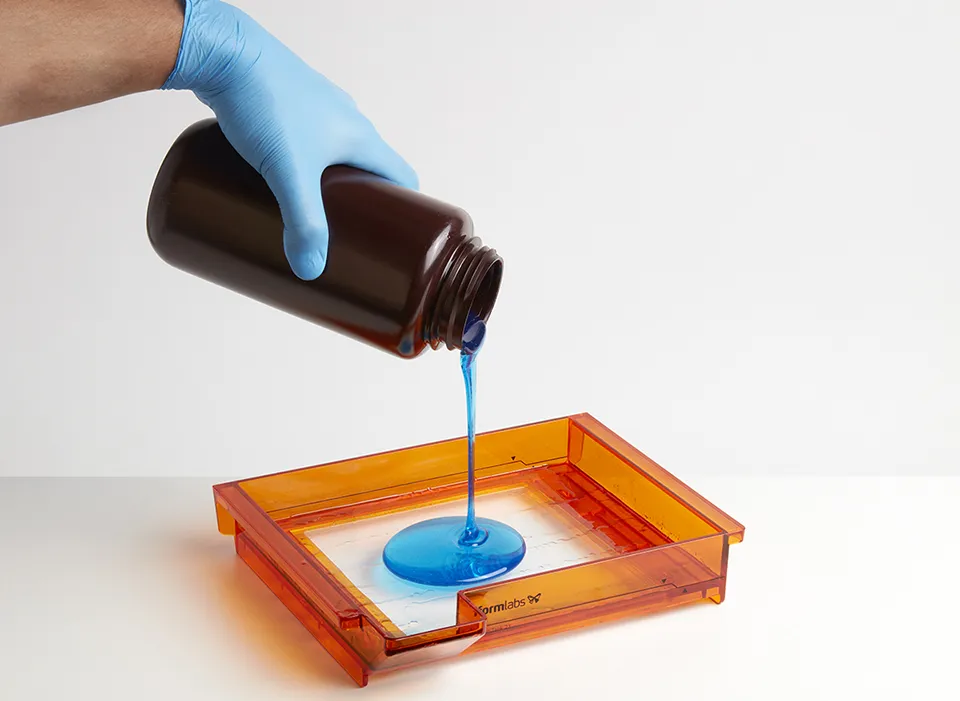
Resin Vat Preparation
Liquid photopolymer resin is contained in a tank. This resin solidifies as a result of chemical reaction when exposed to UV light.
-

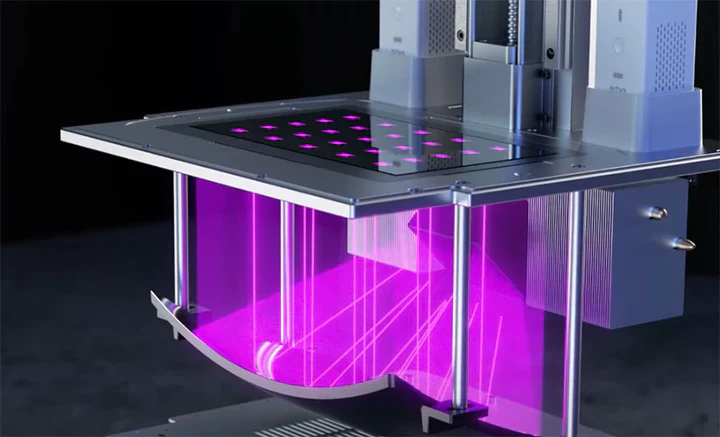
Laser Scanning
A precise UV laser beam scans the resin surface under computer control and draws one layer of the digital design. The areas in contact with the laser cure instantly.
-

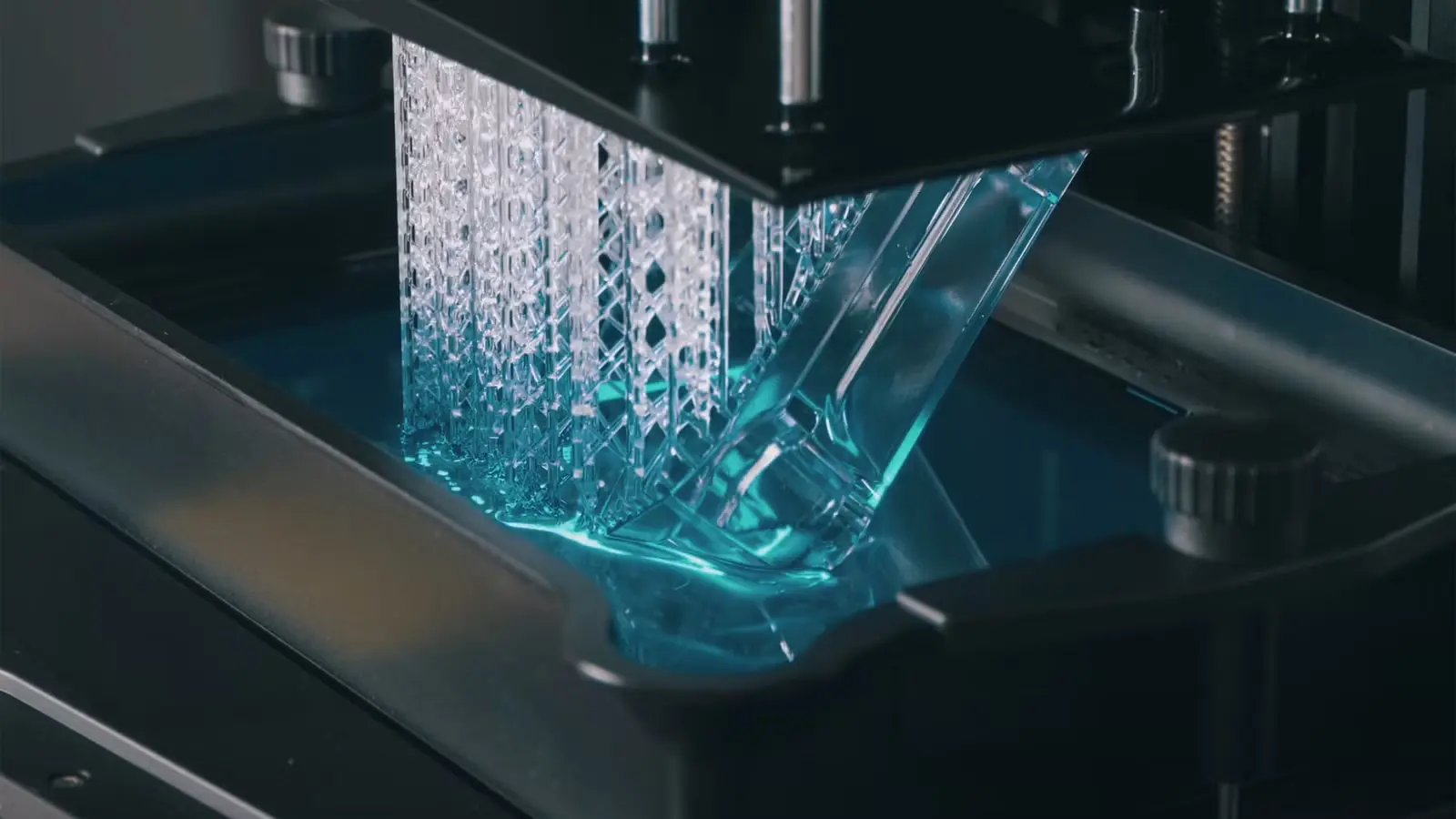
Layer Renewal
After the first layer is completed, the build platform descends a few microns (typically 25-100 microns). The resin surface levels again and becomes ready for the next layer.
-

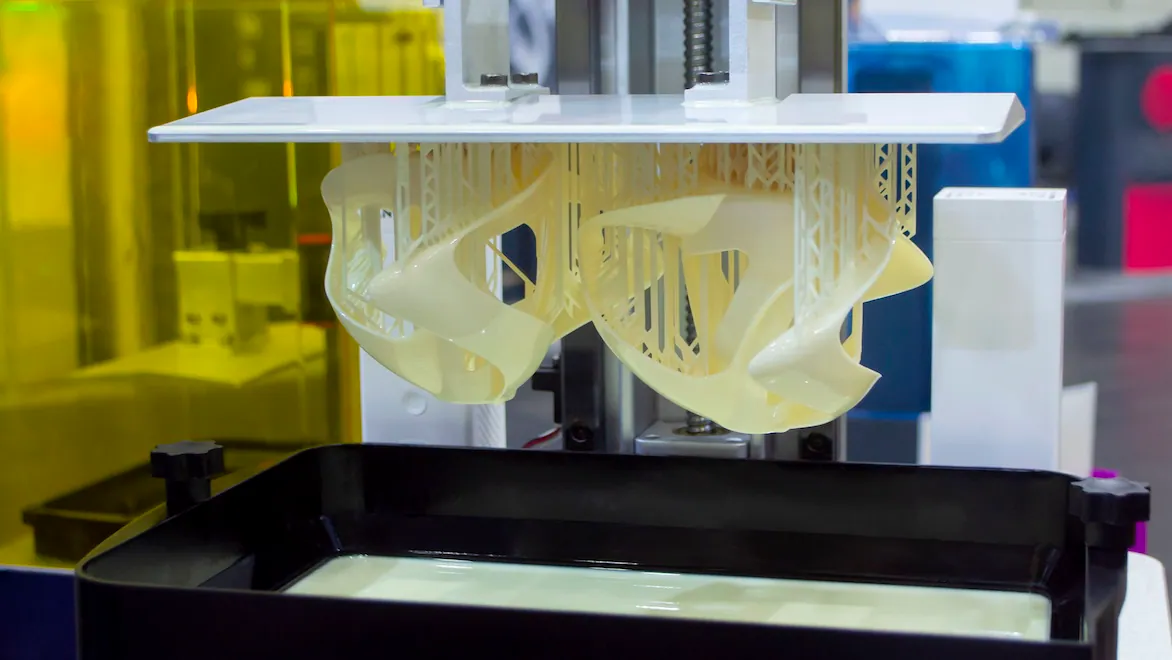
Repetition and Completion
This process is repeated layer by layer until the object is completely formed. Each layer chemically bonds to the previous one, creating a solid structure.
What is DLP 3D Printing?
DLP (Digital Light Processing) is a resin printing technology that works similarly to SLA but uses a digital projector as the light source instead of a laser. This difference leads to significant changes in printing speed and process dynamics.
Basic Working Principle of DLP
DLP technology uses a projector-based system to cure entire layers simultaneously:
Projector Light Source DLP printers contain a projector that uses a digital micromirror array (DMD chip). This projector emits UV or visible light (typically 405nm).
Layer-Based Projection For each layer, the projector reflects the exact image of that layer onto the resin surface. Instead of scanning point by point like a laser, the entire layer is exposed to light simultaneously.
Rapid Curing The light pattern from the projector cures selected portions of the resin in a few seconds. This makes DLP generally faster than SLA.
Platform Movement After the layer is completed, the build platform moves up or down (depending on printer type) and preparation is made for the next layer.
Key Differences Between SLA and DLP
Although both technologies use resin, there are significant technical differences between them:
Light Source
| Feature | SLA | DLP |
|---|---|---|
| Light Type | UV Laser | Projector (LED/UV) |
| Light Shape | Point (scanning) | Layer-based reflection |
| Curing | Point by point | Entire layer simultaneously |
Print Speed
- SLA: Since the laser scans each layer, time is proportional to the part’s surface area
- DLP: Since the entire layer cures simultaneously, layer time is constant (typically 3-10 seconds)
- Result: DLP is faster especially for parts with large surface areas
Resolution and Detail
- SLA: Laser spot size can be very small (50-140 microns), providing high resolution in the X-Y plane
- DLP: Resolution depends on projector resolution and build area size (pixel size typically 35-100 microns)
- SLA Advantage: Consistent detail even for larger build volumes
- DLP Advantage: Very high resolution for small build volumes
Surface Quality
- SLA: Very slight lines may be visible due to laser scanning
- DLP: Pixel-based curing can create very small “voxel” effects under certain light
- Overall: Both are much smoother than FDM
SLA vs. DLP Comparison Table
| Feature | SLA (Stereolithography) | DLP (Digital Light Processing) |
| Speed | Medium/Slow: The laser beam must travel (scan) across the cross-sectional area of each layer individually. Duration increases as the number of parts increases. | Fast: Each layer is cured with a single flash of light (the entire surface at once), similar to a projection screen. The number of parts on the build plate does not affect the duration. |
| Resolution | Very High: Resolution depends on the laser’s focal point. Ideal for very fine details and sharp edges. | High: Resolution depends on pixel (voxel) size. As the printing area grows, pixels can enlarge, which may lead to a loss of detail. |
| Surface Quality | Smooth: Since the laser can move in circular paths, it provides a nearly flawless and smooth finish on curved surfaces. | Very Good: Generally high quality, but microscopic “stair-stepping” effects caused by pixels may be visible upon close inspection. |
| Cost | Higher: Maintenance and setup costs for industrial laser systems are higher compared to DLP. | More Economical: The light source (projector/LED) has a longer lifespan, and maintenance costs are generally lower. |
| Accuracy and Precision | High: Maintains dimensional stability even in large parts. | Medium/High: Very precise for small parts, but optical distortions may occur in large build areas. |
Resin Types and Material Options
Materials used in resin-based 3D printing are specially formulated according to different application requirements.
Standard Resins
General Purpose Resin The most commonly used resin type. Suitable for visual models, concept prototypes, and form control. Economical and easy to process.
Rigid Resin Formulated for applications requiring high hardness and dimensional stability. Ideal for snap-fit parts and structural tests.
Clear Resin Used for applications requiring optical transparency. Preferred in areas such as lens prototypes, liquid flow visualization, and light guides.
Engineering Resins
ABS-Like Resin Resins that mimic the mechanical properties of ABS plastic. Produces parts with high toughness, resistant to breakage.
PP-Like Resin Offers polypropylene-like properties. Flexible, durable, and chemically resistant. Excellent for living hinges and snap-fit connections.
High Temperature Resin Special formulations that can withstand temperatures between 80-200°C. Used for injection molds, automotive testing, and thermal tests.
Special Application Resins
Dental Resins Biocompatible, FDA-approved resins. Used for dental models, surgical guides, temporary crowns, and orthodontic appliances.
Castable Resins Specially developed for jewelry and precision casting applications. Provides flawless metal conversion with the lost-wax method.
Flexible Resins Resins offering rubber-like elasticity. Used for gaskets, insulation elements, and silicone-like parts.
Washable Resin Eco-friendly resins that can be cleaned with water instead of alcohol after printing. Simplifies workflow and reduces cost.
Resin Properties Comparison Table
| Resin Type | Hardness | Toughness | Heat Resistance | Typical Application |
|---|---|---|---|---|
| Standard | Medium | Low | 50-60°C | Visual models, concept prototypes |
| ABS-Like | High | High | 60-80°C | Functional tests, snap-fit parts |
| PP-Like | Medium | Very High | 50-70°C | Living hinges, flexible connections |
| High Temperature | Very High | Medium | 150-200°C | Molds, automotive tests |
| Dental | High | Medium | 60-80°C | Dental models, surgical guides |
| Castable | Medium | Low | – | Jewelry, precision casting |
| Flexible | Low | Very High | 40-60°C | Gaskets, flexible parts |
You can find a more detailed comparison on our SLA/DLP Material Comparison page.
Advantages of SLA/DLP Printing
Resin-based 3D printing technologies offer distinct advantages over FDM and other methods in many areas.
Exceptional Surface Quality
Parts produced with SLA and DLP have ultra-smooth surfaces where layer lines are nearly invisible. This feature:
- Minimizes sanding and surface treatments
- Is ideal for professional presentation parts
- Shortens pre-painting preparation time
- Delivers excellent results in visual and aesthetic models
High Resolution and Precision
Resin technologies can produce micron-level details:
- Layer thickness: 25-100 microns (FDM: 100-400 microns)
- XY resolution: 35-140 microns
- Precision tolerances: ±0.05-0.1 mm
- Thin walls: down to 0.4 mm
This precision is critically important in these areas:
- Jewelry and accessory production
- Dental applications
- Medical models
- Precision engineering parts
Complex Geometries
Ability to produce thin, hollow, and complex geometries without problems:
- Lattice structures
- Thin walls and membranes
- Small holes and channels
- Detailed surface textures
Wide Material Range
Specially formulated resins meet very diverse application requirements:
- Engineering resins for mechanical tests
- Biocompatible materials for medical applications
- Burnable resins for casting
- Elastomeric resins for flexible applications
Isotropic Mechanical Properties
Unlike FDM, the strength of resin prints is direction-independent:
- Similar strength in X, Y, Z axes
- Minimal inter-layer weak point problem
- Reliable mechanical performance
Clean and Quiet Operation
- Minimal noise level
- Controlled resin vapors thanks to enclosed system
- Suitable for office and laboratory environments
Disadvantages of SLA/DLP Printing
Like every technology, resin-based printing has some limitations and challenges.
Post-Processing Requirements
Cleaning Process After printing is completed, liquid resin remaining on the part must be cleaned:
- Isopropyl alcohol (IPA) bath required
- Ultrasonic cleaner use recommended
- Two-stage washing process (rough + fine)
- Requires special waste management
UV Curing For parts to reach full mechanical properties:
- Must be kept under light for 5-30 minutes in UV curing device
- Must be rotated for uniform light distribution
- Requires additional equipment investment
Support Removal Manual removal of delicate support structures:
- Requires patience and attention
- Risk of breakage in thin parts
- Support marks must be cleaned afterwards
Material Cost
Resins are significantly more expensive than FDM filaments:
- Standard resin: $50-150/kg
- Engineering resins: $150-500/kg
- Special resins (dental, castable): $500-1500+/kg
- Comparison: PLA filament ~$20-30/kg
Limited Build Volume
Most desktop and mid-level SLA/DLP printers:
- Build volume: 10x10x15 cm to 20x20x30 cm
- Industrial FDM: 40x40x60 cm or larger
- Large parts cannot be produced or must be printed in sections
Mechanical Strength Limitations
Most resins, compared to FDM engineering plastics:
- More brittle (especially standard resins)
- More sensitive to UV and heat
- Risk of yellowing and mechanical degradation over time
- Limited durability in outdoor applications
Health and Safety
Liquid resins require special attention:
- Can be skin irritant
- Glove use mandatory
- Good ventilation required
- Waste management subject to environmental regulations
- Not recommended for pregnant women and sensitive individuals
Shelf Life
Unopened resins:
- 6-12 months shelf life
- Must be protected from sunlight
- Must be stored under temperature control
- Should be used within 3-6 months after opening
SLA/DLP and FDM Comparison
Let’s make a detailed comparison for the right technology selection:
Comprehensive Technology Comparison Table
| Feature | SLA/DLP | FDM |
|---|---|---|
| Surface Quality | Excellent (smooth, detailed) | Medium (visible layer lines) |
| Resolution | Very high (25-100 microns) | Medium (100-400 microns) |
| Precision | ±0.05-0.1 mm | ±0.2-0.5 mm |
| Mechanical Strength | Medium (isotropic, can be brittle) | High (anisotropic) |
| Material Variety | Wide (special formulations) | Very wide (thermoplastics) |
| Build Volume | Small-Medium (max 30 cm typically) | Large (1m+ possible) |
| Print Speed | Medium-Fast (layer-based) | Slow-Medium (area-based) |
| Material Cost | High ($50-500+/kg) | Low ($20-50/kg) |
| Equipment Cost | Medium-High ($1,500-20,000+) | Low-Medium ($500-10,000) |
| Post-Processing | Mandatory (washing + curing) | Minimal (support removal) |
| Ease of Use | Medium (chemical use required) | High (simple operation) |
| Maintenance | Medium (resin change, cleaning) | Low (minimal maintenance) |
| Waste Management | Mandatory (chemical waste) | Minimal (plastic waste) |
| Work Safety | Attention required (protective equipment) | Safe (only hot surface) |
| Office Suitability | Medium (ventilation needed) | High (minimal odor) |
Which One for Which Situation?
SLA/DLP Should Be Preferred:
- If high detail and smooth surface are critical
- Jewelry, dental, medical applications
- If precision tolerances are needed (±0.1 mm)
- Visual presentation models
- Complex geometries and thin walls
- Transparent or translucent parts
- Casting molds (lost-wax)
FDM Should Be Preferred:
- Large parts (30 cm+)
- If high mechanical strength is needed
- Functional prototype and tests
- Frequently used end-use parts
- If low cost is important
- If you want minimal post-processing
- Outdoor use or high temperature
Application Areas
SLA and DLP technologies have become indispensable in many sectors requiring precision and surface quality.
Dentistry and Dental Applications
The dental sector is one of the largest users of resin printing:
- Dental models: Orthodontic planning and implant placement
- Surgical guides: Precise implant positioning
- Temporary crowns and bridges: Patient-specific production
- Clear aligners: Orthodontic treatment molds
- Denture bases: Trial and final dentures
- Braces and appliances: Custom orthodontic devices
Jewelry and Accessory Production
An excellent solution for the jewelry industry:
- Master models: Molds for metal casting
- Lost-wax method: Direct production with castable resins
- Rapid prototyping: Design iterations
- Detailed patterns: Fine filigree and textures
- Small series: Custom design and limited production
Medical and Anatomy Models
Widespread use in the healthcare sector:
- Surgical planning: Patient-specific anatomical models
- Training models: Student and patient education
- Custom implants: Biocompatible prosthetics
- Light guides: Medical devices
- Microfluidic devices: Lab-on-chip applications
Miniatures and Hobby
Detailed small-scale production:
- Wargaming figures: 28-75mm detailed models
- Architectural models: Scale buildings and structures
- Collectibles: Limited series production
- Toys and figures: Custom characters
Product Development and Prototyping
In professional product development:
- Visual prototypes: Customer presentations
- Form and ergonomics tests: User experience
- Snap-fit tests: Assembly control
- Transparent parts: Liquid flow visualization
- Optical prototypes: Lenses and lighting
Electronics and Consumer Products
Precision product enclosures:
- Custom electronic housings: Custom designs
- Lenses and optical parts: Camera and projector elements
- In-ear accessories: Earphones and hearing aids
- Wearable device prototypes: Wearable technology
SLA/DLP 3D Printing Usage Rates by Sector
SLA and DLP technologies are most commonly used in the dentistry (dental) sector with a rate of 30%, thanks to the exceptional detail precision they provide. Jewelry, where microscopic details are critical, ranks second at 20%; while medical applications and consumer goods both hold a 15% usage share. Industrial manufacturing accounts for 12%, and aerospace & automotive represent 8%, utilizing this precision technology primarily in prototyping processes. This distribution demonstrates the dominance of resin-based printing technologies in “high surface quality” focused industries.
Tips and Best Practices
Things to pay attention to for successful SLA/DLP printing:
Design Tips
Wall Thickness
- Minimum wall thickness: 0.4-0.8 mm
- For structural parts: 1-2 mm recommended
- Very thin walls can be fragile
Support Structures
- Supports required at angles over 45°
- Support placement critical – proper positioning important
- Support thickness: 0.4-0.6 mm (for ease of removal)
- Support contact points should be minimal (to avoid marks)
Drainage Holes
- Always open drainage hole in hollow parts
- Hole diameter: minimum 3-5 mm
- Necessary for excess resin to drain
Orientation
- Position part at 15-30° angle
- Don’t let flat surfaces contact platform
- Minimize vacuum effect
Print Parameters
Layer Thickness
- For detail: 25-50 microns
- Standard: 50-100 microns
- Fast printing: 100 microns
Light Exposure Time
- Varies by resin (3-15 seconds/layer)
- Too little: Weak layer adhesion
- Too much: Over-polymerization, dimensional deviations
Print Speed
- Platform lift speed: Slow (for resin flow)
- High speed: Layer separation problems
- Large parts: Slower speed
Post-Processing Recommendations
Cleaning
- Wear gloves
- Separate from support platform with spatula
- First IPA bath (2-3 minutes, with soft brush)
- Second IPA bath (2-3 minutes, clean alcohol)
- Dry with air or wipe with towel
Curing
- Use UV curing device
- Time: 5-30 minutes (depending on resin)
- Rotate part so all surfaces receive light
- Sunlight is alternative but control difficult
Support Removal
- Use chisel or pliers
- Be careful with delicate parts
- Smooth marks with fine sandpaper (400-600 grit)
Surface Improvement
- Sanding: 400 → 800 → 1200 grit
- Polishing compound
- For clear resins: Sandpaper + varnish
Frequently Asked Questions (FAQ)
Which is better between SLA and DLP?
Both deliver excellent results. DLP is generally faster because it cures the entire layer simultaneously. SLA offers more consistent resolution for larger build volumes. DLP can be preferred for small-medium parts and if speed is priority, SLA if you want large parts and maximum detail.
How durable are resin prints?
Depends on resin type. Standard resins can be brittle, but ABS-like or PP-like engineering resins are quite robust. In the long term, UV light and moisture can reduce the mechanical properties of resin parts. They’re suitable for functional tests, but long-term outdoor use is limited.
Is resin printing expensive?
Yes, more expensive than FDM. Resin cost ranges from $50-500 per kg. Additionally, IPA cleaning cost and UV curing equipment are needed. However, in applications requiring high detail and surface quality, this cost is justified.
Is resin harmful?
Liquid resin can cause skin irritation and allergies. Gloves must be used and good ventilation provided. Uncured resin is riskier; it’s much safer after fully cured. Pregnant women and people with sensitive skin should be careful.
How long does post-processing take?
15-45 minutes total for a small part. Cleaning ~10 minutes, curing 10-30 minutes, support removal 5-15 minutes. Large or complex parts may take longer.
How large can parts be printed with SLA/DLP?
Most desktop printers have build volumes between 10x10x15 cm and 20x20x30 cm. Industrial systems can go up to 40x40x50 cm. Larger parts must be printed in sections and then assembled.
Which sectors use SLA/DLP?
Primarily dentistry (30-40%), jewelry (20-25%), medical (15-20%), consumer electronics (10-15%), and prototyping services. Any sector requiring precision detail can use it.
Can resin prints be colored?
Yes, post-print painting is possible. Resins hold paint even without primer. Also, colored resins are available (clear, white, gray, black, red, etc.). However, there isn’t as wide a color range as FDM.
Conclusion
SLA and DLP 3D printing technologies are ideal solutions for professionals seeking high precision, exceptional surface quality, and the ability to produce complex geometries. By producing parts at detail levels that FDM cannot reach, they have found usage areas in a wide range from dentistry to jewelry, from medical applications to precision prototyping.
Although both technologies are resin-based, DLP’s ability to cure entire layers simultaneously provides a speed advantage, while SLA’s point-by-point scanning principle offers more consistent results for large build volumes. Material diversity offers options that can be optimized for each application with specially formulated resins.
Despite disadvantages such as post-processing requirements, high material cost, and limited build volumes, the quality these technologies offer is indispensable for many applications. The right technology selection should be made by carefully evaluating your project requirements (detail level, part size, mechanical properties, cost).
Working with a professional team will ensure you get the best results at every stage from technology selection to post-processing optimization.
Quote in Seconds, Parts in Days
Upload your 3D CAD files, select your manufacturing technology, and receive an instant cost analysis. Zero wait time, no minimum order requirements.