


Plastic
PETG Filament (Tough)
Tough Engineering Plastic
Tough engineering material combining PLA's ease of use with ABS's durability and high chemical resistance.
| Compatible Technologies | FDM Printing |
| Tensile Strength | 31.9 MPa |
| Heat Deflection Temperature (HDT) | 84°C |
| Hardness | - |
| Available Colors | Black, Translucent, White |
Upload your CAD files and receive a custom quote within 2 hours.
Your uploads are confidential and secure.
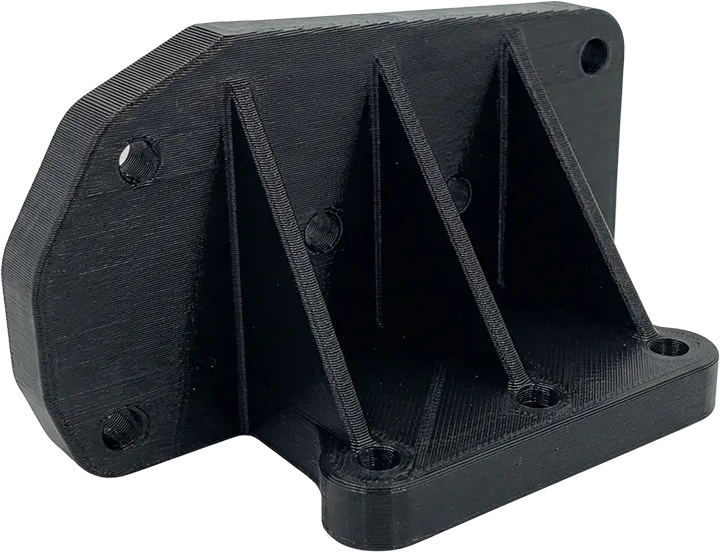
Why Choose PETG Filament (Tough)?
PETG Filament is the glycol-modified version of the PET plastic we know from everyday water bottles, optimized for 3D printing. In FDM 3D Printing, it stands out as an “engineering thermoplastic” that combines the ease of printing of PLA with the mechanical strength of ABS. Its most notable feature is its high toughness; unlike ABS which whitens or PLA which snaps under impact, PETG flexes to absorb energy. Additionally, its resistance to acids, alkalis, and solvents makes it an excellent choice for industrial fluid container prototypes and outdoor fixtures.
Advantages
High Toughness: Non-brittle; exhibits high resistance to impacts and bending thanks to its flexibility.
Chemical Resistance: Resistant to oils, greases, acids, and solvents; suitable for industrial environments.
Excellent Layer Adhesion: Layers bond extremely well, allowing for the production of watertight parts.
Food Compliance: Raw material is food-safe (Though surface coating is recommended to prevent bacterial growth in layer lines).
Limitations
Stringing: Can leave fine strings behind as the nozzle moves during printing (Minimized with settings but may require cleanup).
Support Removal: Because layer adhesion is so strong, removing support structures is more difficult than with PLA.
Surface Finishing: Cannot be smoothed with acetone vapor like ABS; sanding is slightly harder due to its flexible nature.
Mechanical Properties
Metric Measurements
Elastic Modulus
1.47 GPa
Elongation at Break
6.8 %
Density
1.3 g/cm³
PETG Filament FAQ
What is the difference between PETG Filament and ABS?
PETG Filament is more flexible and tough than ABS, and it does not warp like ABS during printing. However, in terms of heat resistance, ABS (100°C) is superior to PETG Filament (75°C).
Can PETG Filament be used outdoors?
Yes. PETG Filament is more resistant to UV rays than ABS and lasts longer outdoors. It is frequently preferred for signage letters, outdoor brackets, and Automotive and Mobility accessories.
Can I make containers for chemicals?
Absolutely. PETG Filament is one of the most chemically resistant FDM materials. Prototype bottles and reservoirs for industrial cleaners or oils can be safely produced with PETG Filament.
Is PETG Filament watertight?
No, it is watertight. PETG Filament has the strongest layer adhesion. When printed with correct settings, it provides water and air tightness. This makes it ideal for fluid flow tests in Functional Prototyping.
Is it food safe?
PETG Filament is chemically suitable for food contact (made from FDA-approved raw materials). However, since bacteria can lodge between 3D printed layers, coating with epoxy is recommended for direct food contact.
Can the parts be transparent?
PETG Filament is naturally a clear material. When printed with 100% infill and sanded, a “translucent” (frosted glass) appearance can be achieved, which is advantageous for light-transmitting parts.
Quote in Seconds, Parts in Days
Upload your 3D CAD files, select your manufacturing technology, and receive an instant cost analysis. Zero wait time, no minimum order requirements.