


Composite
Heat Resistant Epoxy Board
High Temp Tooling Board
Heat-resistant rigid epoxy tooling board designed for composite manufacturing (Prepreg/Autoclave).
| Compatible Technologies | RIM Molding |
| Tensile Strength | - |
| Heat Deflection Temperature (HDT) | 174°C |
| Hardness | - |
| Available Colors | Black |
Upload your CAD files and receive a custom quote within 2 hours.
Your uploads are confidential and secure.
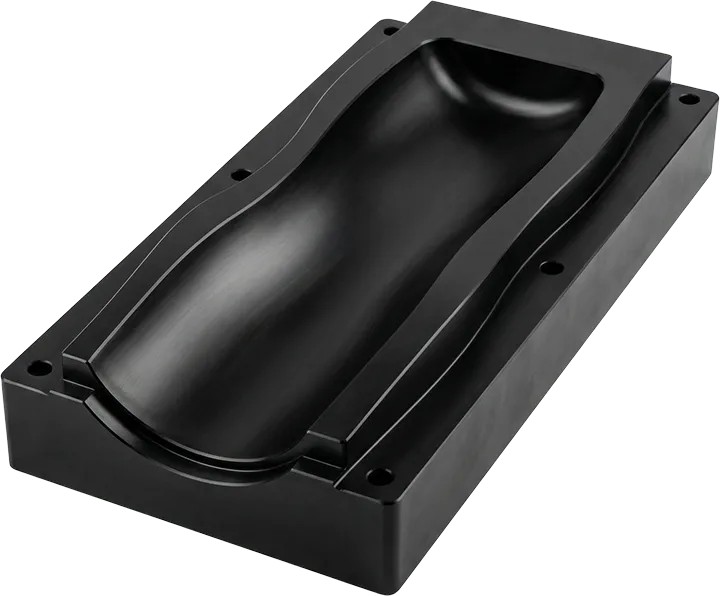
Why Choose Heat Resistant Epoxy Tooling Board?
Heat Resistant Epoxy Tooling Board is a high-performance machining material developed specifically for composite part manufacturing and high-temperature curing processes. Unlike standard polyurethane boards, its specialized epoxy formulation maintains dimensional stability at temperatures between 120°C and 200°C. This makes it the fastest alternative to aluminum for “Prepreg Carbon Fiber” lay-up tools requiring autoclave or oven curing, widely used in Aerospace and defense projects.
Advantages
High Temperature Resistance: Retains form and hardness during autoclave and oven curing cycles without softening.
Low Thermal Expansion (CTE): Exhibits minimal expansion during temperature shifts, ensuring the dimensional accuracy of carbon fiber parts.
Excellent Surface Quality: Achieves “Class A” glossy surfaces with proper sealing applications.
Cost & Speed: Machines significantly faster than metal molds on CNC mills, reducing costs in Rapid Tooling and Casting processes.
Limitations
Cost: Raw material price is higher than standard polyurethane modeling blocks.
Brittleness: Due to its hard, glass-like structure, it is sensitive to impacts; edges must be handled with care.
Preparation: Requires professional sealing and release agents to prevent resin adhesion.
Mechanical Properties
Metric Measurements
Elastic Modulus
GPa
Elongation at Break
%
Density
0.7 g/cm³
Epoxy Tooling Board FAQ
Which industry uses Epoxy Tooling Board the most?
Heat resistant epoxy tooling board is predominantly used in aerospace, Defense and Security, and motorsports industries as the primary tooling material for manufacturing “Prepreg Carbon Fiber” parts.
What are the temperature limits of Epoxy Boards?
he epoxy tooling board grades we use can withstand temperatures ranging from 120°C up to 200°C (depending on density). These limits are defined by the Glass Transition Temperature (Tg). For technical definitions, refer to Glass Transition Temperature – Special Chem.
Why use Epoxy Board instead of Aluminum molds?
For low-to-medium volume composite production, using epoxy tooling board is much faster than aluminum. CNC machining time is shorter, and its Coefficient of Thermal Expansion (CTE) is more compatible with composite parts than metal.
Can Epoxy Board be used as a mold immediately after machining?
No. After machining, the surface micropores of the epoxy tooling board must be sealed. It becomes ready for use only after applying specific sealers recommended by our Engineering and Design Support team.
Is it resistant to autoclave pressure?
Yes. High-density epoxy tooling board (typically 0.70 g/cm³ and above) possesses high compressive strength, ensuring it does not crush under vacuum and pressures up to 6 bar within an autoclave.
Why is the Coefficient of Thermal Expansion (CTE) important for Epoxy Boards?
If a mold expands significantly like metal when heated, the resulting carbon fiber part may be off-spec upon cooling. Epoxy tooling board has a very low CTE, minimizing this risk and ensuring precise production.
Quote in Seconds, Parts in Days
Upload your 3D CAD files, select your manufacturing technology, and receive an instant cost analysis. Zero wait time, no minimum order requirements.