


Elastomer
Elastic Resin (Soft)
80A Shore Soft Resin
80A Shore hardness flexible resin that is bendable and returns to its original shape, ideal for soft-touch parts.
| Compatible Technologies | SLA/DLP Printing |
| Tensile Strength | 5 MPa |
| Heat Deflection Temperature (HDT) | - |
| Hardness | 71 (Shore A) |
| Available Colors | Clear |
Upload your CAD files and receive a custom quote within 2 hours.
Your uploads are confidential and secure.
Why Choose Flexible (Elastic) Resin?
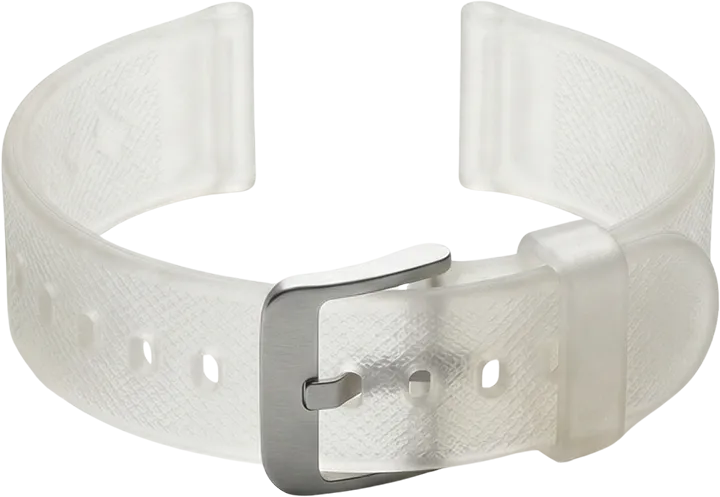
Flexible (Elastic) Resin is an SLA 3D printing material with a hardness range typically between 50A and 80A Shore, offering silicone-like softness and rebound properties. Produced with Resin 3D Printing (SLA / DLP) technology, these parts feature a much smoother surface and higher detail precision compared to TPU filaments. They deform when compressed and return to their original form when the force is removed. It provides rapid results for prototyping wearable tech straps, soft robotic grippers, ergonomic handles, and custom gaskets without the need for expensive silicone molding.
Advantages
Silicone-Like Behavior: Bendable, compressible, and stretchable; mimics the haptic feel of silicone.
High Energy Damping: Absorbs shocks and dampens vibration; acts as a buffer for protecting sensitive components.
Ergonomics: Offers comfortable use in skin-contact parts like earphone tips and watch straps.
Complex Geometries: Can produce complex undercuts and hollow flexible structures that are impossible to manufacture with silicone molding.
Limitations
Tear Strength: Lower tear resistance compared to actual silicone rubber; should not be over-stretched.
Support Marks: Due to its flexibility, it requires extensive support structures during printing, leaving small marks where supports are removed.
Hardening Over Time: Continues to cure when exposed to UV light, potentially losing flexibility and becoming harder over time.
Mechanical Properties
Metric Measurements
Elastic Modulus
0.05 GPa
Elongation at Break
70 %
Density
1.12 g/cm³
Elastic Resin FAQ
What is the difference between Elastic Resin and TPU Filament?
The biggest difference is surface quality and detail. TPU parts printed with FDM are rough. Flexible (Elastic) Resin (SLA) is smooth and much closer to a silicone texture. However, TPU is superior in terms of durability.
Can I make watertight gaskets with this material?
Yes. Flexible (Elastic) Resin provides sealing by filling gaps between surfaces when compressed. It is reliably used in the Functional Prototyping stages of custom gasket designs.
What is the Shore hardness of Elastic Resin?
The Flexible (Elastic) Resin we use typically ranges between 50A and 80A Shore. 50A Shore is like a rubber band, while 80A Shore is comparable to a shoe sole or leather belt.
Is it suitable for skin-contact products?
Yes, it is suitable for short-term contact. Specifically, patient-specific mask adapters in Medical and Healthcare Technologies or smart watch strap prototypes in Consumer Electronics are produced with Flexible (Elastic) Resin.
Can the parts be painted?
Painting flexible parts is difficult because the paint cracks when the part stretches. However, since Flexible (Elastic) Resin is translucent, it can be dyed to the desired color by dipping it in colored alcohol solutions after printing.
Does it replace real silicone?
Flexible (Elastic) Resin is an excellent visual and functional mimic of silicone for prototyping and low-volume production. However, if high heat resistance or elasticity lasting for years is required, real silicone casting via Vacuum Casting Services is recommended for final production.
Quote in Seconds, Parts in Days
Upload your 3D CAD files, select your manufacturing technology, and receive an instant cost analysis. Zero wait time, no minimum order requirements.