


Plastic
CNC Modelling Block (Lightweight)
Low Density Modelling Block
Low-density, easily machinable, and dimensionally stable economical master modelling block for CNC.
| Compatible Technologies | Vacuum Casting |
| Tensile Strength | 25 MPa |
| Heat Deflection Temperature (HDT) | 78°C |
| Hardness | 61 (Shore D) |
| Available Colors | Brown |
Upload your CAD files and receive a custom quote within 2 hours.
Your uploads are confidential and secure.
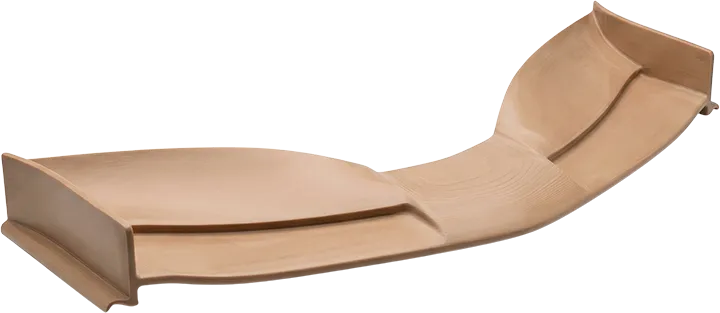
Why Choose CNC Modeling Block (Lightweight)?
Lightweight CNC Modeling Block is a low-density polyurethane material developed specifically for the economical production of large-scale models and initial form studies. Being significantly lighter than standard blocks, it offers ease of transport and assembly, especially in Architecture and Construction projects and massive parts like wind energy blade patterns. Capable of being machined at record speeds on CNC mills, this material is the fastest and most budget-friendly solution for validating the volumetric form of a design.
Advantages
Cost-Effectiveness: Unit cost is much lower than standard density blocks, protecting the budget on large-volume projects.
Rapid Machining: Its low density allows for very high feed rates during roughing and finishing on CNC machines.
Easy Sandability: Machining marks can be removed manually with very little effort using sandpaper.
Lightweight: Allows large models to be moved and assembled without the need for cranes or heavy lifting equipment.
Limitations
Surface Porosity: Due to low density, the surface is more porous than standard blocks; putty and primer (surface filler) are required for a smooth paint finish.
Mechanical Strength: It is very soft and can be dented even by a fingernail. Not suitable for functional tests or load-bearing parts.
Detail Resolution: May not hold sharp edges as crisply as standard blocks; very fine details might chip.
Mechanical Properties
Metric Measurements
Elastic Modulus
1.25 GPa
Elongation at Break
4 %
Density
0.7 g/cm³
Lightweight Modeling Board FAQ
What is the difference between Lightweight and Standard Modeling Boards?
The main difference is density. While CNC Modelling Block (Standard) has a tighter structure yielding a smooth finish, Lightweight Modeling Block is more porous but significantly cheaper and faster to machine.
Can this material be painted?
Yes, but surface preparation is required. Since the material is porous, a filler putty or high-build primer must be applied and sanded first. After this process, painted surfaces of Concept Prototyping – Visual Models quality can be achieved.
What projects is it best suited for?
It is the ideal material for yacht/boat hull patterns, wind turbine blade master models, large-scale sculptures, and architectural massing studies.
How fast is the CNC machining process?
Lightweight CNC Modeling Block can be machined 10-20 times faster than aluminum and 2-3 times faster than standard blocks. This saves significant time on large projects requiring urgent delivery.
Can it be used as a master model for vacuum casting?
It is not recommended for direct use because surface pores will transfer to the silicone. However, if the surface is filled and made completely smooth, it can be used in Rapid Tooling and Casting processes.
How does it differ from Styrofoam (EPS)?
Styrofoam (EPS) has a beaded structure that results in a rough surface when machined. Lightweight Modeling Block (Polyurethane) is more homogeneous, does not tear out beads, and offers much sharper details.
Quote in Seconds, Parts in Days
Upload your 3D CAD files, select your manufacturing technology, and receive an instant cost analysis. Zero wait time, no minimum order requirements.