


Plastic
ABS Filament (Industrial)
Engineering Plastic
Impact-resistant and machinable industrial plastic with moderate heat deflection properties.
| Compatible Technologies | FDM Printing |
| Tensile Strength | 33 MPa |
| Heat Deflection Temperature (HDT) | 98°C |
| Hardness | - |
| Available Colors | Black, Gray, White |
Upload your CAD files and receive a custom quote within 2 hours.
Your uploads are confidential and secure.
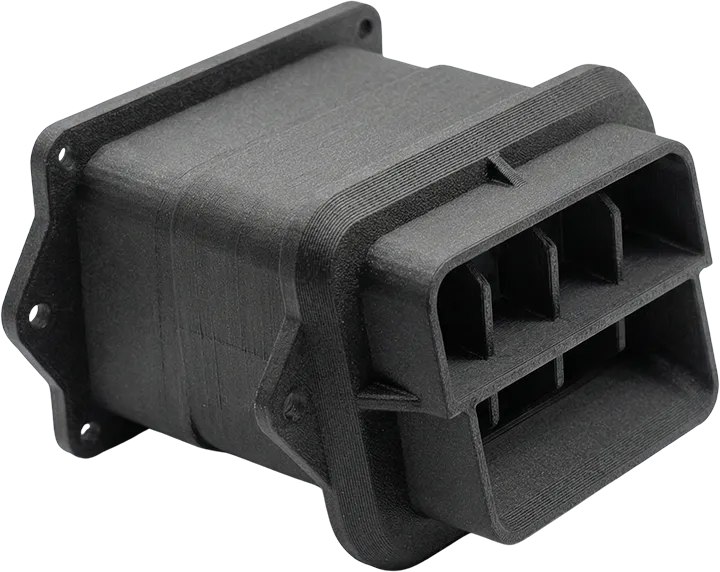
Why Choose ABS Filament (Industrial)?
ABS Filament (Acrylonitrile Butadiene Styrene) is a petroleum-based thermoplastic known for the impact resistance and toughness familiar to us from LEGO bricks. In FDM 3D Printing, it is considered the industry standard for parts requiring mechanical durability and heat resistance. Unlike PLA, it can withstand temperatures up to 100°C and has enough flex to resist breaking under stress. These properties make it indispensable for under-hood prototypes in the Automotive and Mobility sector, electronic enclosures, and moving mechanisms. It is also the easiest material to sand and smooth using acetone vapor.
Advantages
High Heat Resistance: Retains its form up to approx. 95-100°C, does not deform in hot environments.
Impact Resistance: Hard and tough; significantly more durable against drops and impacts than PLA.
Excellent Machinability: Can be sanded, drilled, painted, and chemically welded with acetone after printing.
Durability: Retains its properties for years in indoor applications and under mechanical load.
Limitations
UV Sensitivity: Can yellow and become brittle upon prolonged exposure to sunlight (ASA is recommended for outdoors).
Warping: High tendency to shrink while cooling, requiring professional printers with enclosed, heated chambers.
Odor: Emits a slight plastic smell during printing (managed via ventilation in our facility).
Mechanical Properties
Metric Measurements
Elastic Modulus
2.17 GPa
Elongation at Break
2.7 %
Density
1.12 g/cm³
ABS Filament FAQ
What is the main difference between ABS Filament and PLA?
The main difference is durability and heat resistance. ABS Filament can withstand up to 100°C, whereas PLA softens at 60°C. Additionally, ABS Filament is more flexible and tough against impacts, resisting breakage.
Can ABS Filament parts be used outdoors?
ABS Filament is sensitive to UV rays and can degrade under prolonged sunlight. For outdoor projects, we recommend ASA filament instead of ABS Filament, as it offers similar properties with enhanced UV resistance.
How is the surface quality and can it be smoothed?
Layer lines are visible due to FDM technology, but ABS Filament is the easiest material to sand. Furthermore, ABS Filament surfaces can be made glossy and smooth like injection-molded parts using acetone vapor smoothing.
Can I perform functional testing with ABS Filament?
Absolutely. ABS Filament is the most frequently used material for Functional Prototyping and assembly trials. Snap-fits, gears, and moving hinges can be safely tested with ABS Filament.
Can it be used for end-use products?
Yes. Especially in Low Volume Production projects, electronic housings or machine spare parts are produced with ABS Filament and used as final products after sanding and painting.
Can ABS Filament parts be bonded together?
Yes. ABS Filament can be “welded” together using acetone. This feature allows large parts to be printed in sections and then seamlessly joined using ABS Filament bonding techniques.
Quote in Seconds, Parts in Days
Upload your 3D CAD files, select your manufacturing technology, and receive an instant cost analysis. Zero wait time, no minimum order requirements.