


[get_terms taxonomy="malzeme-turu"]
Biocompatible Dental Resin
Certified Biocompatible Resin
Certified biocompatible resin safe for prolonged skin and mucosal contact, ideal for medical surgical guides.
| Compatible Technologies | SLA/DLP Printing |
| Tensile Strength | 48 MPa |
| Heat Deflection Temperature (HDT) | 69°C |
| Hardness | 73 (Shore D) |
| Available Colors | Transparent Yellow |
Upload your CAD files and receive a custom quote within 2 hours.
Your uploads are confidential and secure.
Why Choose Biocompatible Dental Resin?
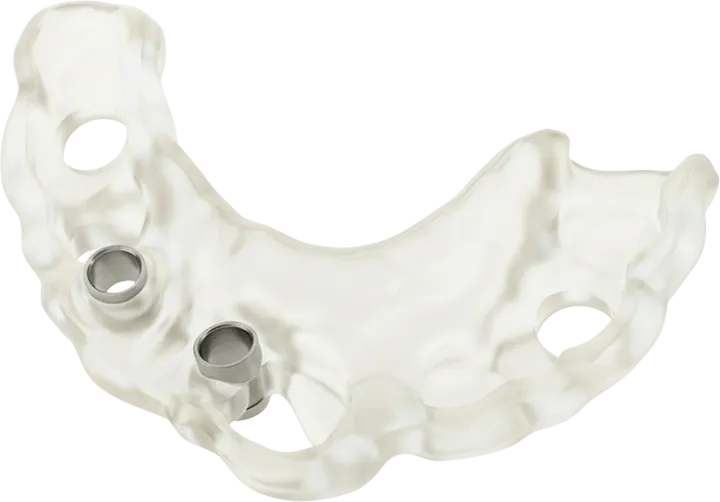
Biocompatible Dental Resin is a certified photopolymer developed for intraoral medical applications, meeting Class I and Class IIa biocompatibility standards. It is indispensable in the Medical and Healthcare Technologies sector, particularly for producing “Surgical Guides” used in implant surgery and diagnostic models. Processed with high-resolution Resin 3D Printing (SLA / DLP), this material is autoclavable, ensuring full compliance with the hygiene requirements of the operating room environment.
Advantages
Biocompatibility: Tested according to ISO 10993 standards; safe for short-term mucosal and bone contact.
Sterilizable: Withstands sterilization in autoclaves under high temperature and pressure without losing form.
High Transparency: Allows the surgeon to clearly see the operation site through the surgical guide.
Dimensional Precision: Produces rigid parts that fit the patient’s anatomy perfectly based on digital tomography data.
Limitations
Duration of Use: Generally approved for short-term contact (less than 24 hours); not suitable for permanent prosthetics or implants.
Post-Processing: Strict adherence to UV curing and washing procedures is required to ensure biocompatibility.
Cost: Raw material cost is higher than standard resins due to medical certification.
Mechanical Properties
Metric Measurements
Elastic Modulus
[acf_group group=”mekanik_ozellikler” field=”elastisite_modulu”] GPa
Elongation at Break
[acf_group group=”mekanik_ozellikler” field=”kopma_uzamasi”] %
Density
[acf_group group=”mekanik_ozellikler” field=”yogunluk”] g/cm³
Nylon-like Technical Resin FAQ
What is Biocompatible Dental Resin used for?
Its most common application is manufacturing Surgical Guides that ensure the drill enters at the correct angle and depth during dental implant surgeries. It is also used for patient-specific splints and try-ins.
Is this material safe for intraoral use?
Yes. After proper post-processing, the resins we use meet ISO 10993 biocompatibility standards. You can refer to ISO Guidance on Biocompatibility for regulatory details.
How is sterilization performed?
Biocompatible resin parts can be sterilized in standard steam autoclaves (typically at 121°C or 134°C). This feature bridges the gap between and clinical application.
Can dental models (plaster replacement) be printed?
Yes. We can produce dental models resistant to high heat and pressure, suitable for thermoforming (aligner pressing) processes.
Why is transparency important?
In surgical guides, transparency allows the surgeon to clearly visualize the drill bit and the gingiva during the operation, minimizing the risk of error.
Can it be used for permanent teeth?
No. This material is typically for surgical and diagnostic aids. For permanent crowns or bridges, ceramic-filled hybrid resins or materials like zirconia should be chosen.
Quote in Seconds, Parts in Days
Upload your 3D CAD files, select your manufacturing technology, and receive an instant cost analysis. Zero wait time, no minimum order requirements.