


[get_terms taxonomy="malzeme-turu"]
Rigid Glass-Filled Resin
Ultra Stiff Technical Resin
Ultra-stiff glass-filled resin with high thermal stability, designed to resist deflection in thin-walled components.
| Compatible Technologies | SLA/DLP Printing |
| Tensile Strength | 64 MPa |
| Heat Deflection Temperature (HDT) | 280°C |
| Hardness | 96D |
| Available Colors | White |
Upload your CAD files and receive a custom quote within 2 hours.
Your uploads are confidential and secure.
Why Choose Rigid Glass-Filled Resin?
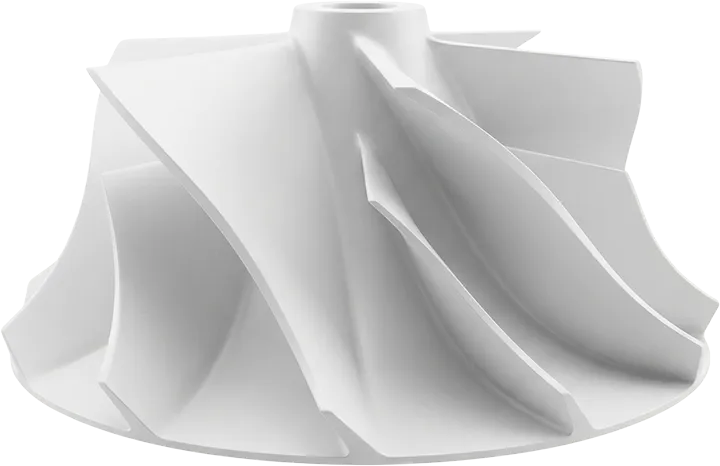
Rigid Glass-Filled Resin is an ultra-stiff SLA 3D printing material reinforced with microscopic glass beads integrated into the photopolymer matrix. Unlike standard resins, it offers superior resistance to deformation under load, boasting a very high flexural modulus. Produced with Resin 3D Printing (SLA / DLP), these parts exhibit excellent dimensional stability and resistance to creep over time. This makes them perfect for checking fixtures, gauges, and thin-walled housings where precision is paramount. Additionally, its enhanced thermal stability allows for safe use in under-hood automotive testing and aerodynamic components like turbine blades.
Advantages
High Stiffness (Modulus): Glass reinforcement provides exceptional resistance to bending; the part maintains its shape under load.
Heat Resistance: Offers a significantly higher Heat Deflection Temperature (HDT) than standard resins, resisting friction heat and environmental stress.
Dimensional Stability: Low shrinkage and high creep resistance ensure the part retains its dimensions even under sustained load.
Smooth & Hard Surface: Glass additives increase surface hardness, improving wear resistance and allowing for a very smooth finish when polished.
Limitations
Brittleness: Due to its extreme hardness, impact resistance is low; it does not flex and may shatter like glass if over-stressed (brittle nature).
Weight: Density is higher than standard resins due to the glass particles.
Color: Typically available in opaque white or grey; full transparency is not possible due to the glass filler.
Mechanical Properties
Metric Measurements
Elastic Modulus
[acf_group group=”mekanik_ozellikler” field=”elastisite_modulu”] GPa
Elongation at Break
[acf_group group=”mekanik_ozellikler” field=”kopma_uzamasi”] %
Density
[acf_group group=”mekanik_ozellikler” field=”yogunluk”] g/cm³
Glass-Filled Resin FAQ
What is the main difference from Standard Resin?
The fundamental difference is rigidity. While standard resins can flex like a plastic ruler, Rigid Glass-Filled Resin behaves more like ceramic or glass; it resists bending. This is critical for precision grippers in Industrial Machinery and Robotics.
What applications is it ideal for?
It is ideal for thin-walled enclosures that must not flex, fan blades, welding fixtures, and manifold prototypes in the Automotive and Mobility sector.
How is the surface quality?
Despite being glass-filled, the surface is remarkably smooth. It can be sanded to a hard, glossy finish. However, due to the material’s hardness, sanding may require slightly more effort than standard resin.
What is the heat resistance?
The Heat Deflection Temperature (HDT @ 0.45 MPa) typically ranges between 70°C and 85°C, depending on the post-curing process. This is sufficient for many functional tests and low-temperature fluid testing.
Is it suitable for snap-fit assemblies?
No. Since the material does not flex, snap-fit tabs will likely break during assembly. For snap-fits, Nylon-Like Engineering Resin (Tough Resin) should be chosen.
Quote in Seconds, Parts in Days
Upload your 3D CAD files, select your manufacturing technology, and receive an instant cost analysis. Zero wait time, no minimum order requirements.