


[get_terms taxonomy="malzeme-turu"]
Carbon Fiber Reinforced Nylon
High Strength Carbon Composite
Carbon fiber reinforced composite offering ultra-high rigidity and strength for metal replacement components.
| Compatible Technologies | FDM Printing |
| Tensile Strength | - |
| Heat Deflection Temperature (HDT) | - |
| Hardness | - |
| Available Colors | Black |
Upload your CAD files and receive a custom quote within 2 hours.
Your uploads are confidential and secure.
Why Choose Carbon Fiber Reinforced Nylon?
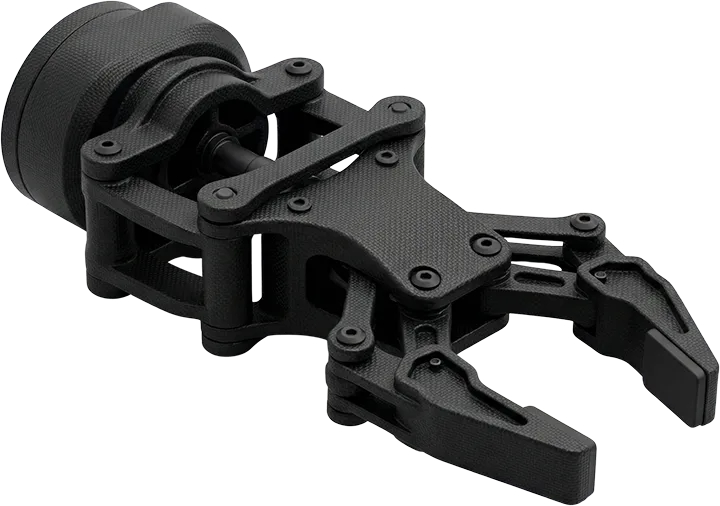
Carbon Fiber Reinforced Nylon (PA-CF) is a high-performance composite material created by embedding chopped carbon fiber particles into industrial Nylon (Polyamide). It boasts the highest Strength-to-Weight ratio among 3D printing thermoplastics. Parts produced via FDM 3D Printing or SLS technologies using PA-CF are stiff and durable enough to replace metal components. It is the ideal solution for engineers looking to reduce weight without compromising strength, particularly in robotic arms, manufacturing fixtures, and UAV airframes, offering a lightweight alternative to aluminum.
Advantages
Metal Replacement: High tensile and flexural strength make it a viable substitute for aluminum parts in many tooling applications.
Lightweight: Significantly lighter than aluminum; reduces inertia in moving parts and improves energy efficiency.
High Heat Resistance: Can withstand temperatures up to 150°C, making it suitable for under-hood applications.
Dimensional Stability: Carbon fiber reinforcement prevents warping during cooling, ensuring high dimensional accuracy even for large parts.
Limitations
Surface Finish: Due to carbon fibers, the surface is matte and slightly textured; not suitable for glossy or cosmetic models.
Brittleness: Less flexible than pure Nylon. Under extreme impact, it tends to crack rather than stretch or flex.
Machinability: Being very hard, it is difficult to sand and can quickly dull drill bits during post-processing.
Mechanical Properties
Metric Measurements
Elastic Modulus
[acf_group group=”mekanik_ozellikler” field=”elastisite_modulu”] GPa
Elongation at Break
[acf_group group=”mekanik_ozellikler” field=”kopma_uzamasi”] %
Density
[acf_group group=”mekanik_ozellikler” field=”yogunluk”] g/cm³
Carbon Fiber Nylon FAQ
Can Carbon Fiber Nylon really replace metal?
Yes. Especially for jigs, fixtures, and brackets that bear load but not extreme impact, PA-CF is a strong alternative to 6061 Aluminum. We frequently use it in our Industrial 3D Printing Services for metal-to-plastic conversion projects.
What does the surface look like?
Parts come out with a characteristic “matte black” or “dark grey” finish. The surface texture is slightly rough (like sandblasted metal) due to the carbon fiber filler, which effectively hides layer lines. It has a technical, industrial look.
Which industries is it suitable for?
It is indispensable for the Aerospace sector (UAV parts) where weight is critical, and the automotive sector (engine mounts) where durability is a must.
What is the heat resistance?
Carbon fiber reinforcement significantly boosts the heat resistance of Nylon. It typically retains mechanical properties up to 140°C – 150°C.
Is it electrically conductive?
Carbon fiber is conductive, while Nylon is insulative. Depending on the fiber loading, PA-CF parts may exhibit slight conductivity or static-dissipative (ESD) properties. This should be considered for electronic enclosures.
How is it different from Pure Nylon (PA12)?
Nylon PA12 (Engineering) is more flexible and impact-absorbent. Carbon Fiber Nylon is much stiffer and rigid. If you need your part not to bend, choose Carbon Fiber; if you need flex, choose Pure Nylon.
Quote in Seconds, Parts in Days
Upload your 3D CAD files, select your manufacturing technology, and receive an instant cost analysis. Zero wait time, no minimum order requirements.