


[get_terms taxonomy="malzeme-turu"]
TPU-E Flexible Filament
Flexible Rubber-Like TPU
High wear-resistant thermoplastic elastomer with excellent rebound, ideal for rubber-like functional parts.
| Compatible Technologies | FDM Printing |
| Tensile Strength | 23.1 MPa |
| Heat Deflection Temperature (HDT) | - |
| Hardness | 95A |
| Available Colors | Black, White |
Upload your CAD files and receive a custom quote within 2 hours.
Your uploads are confidential and secure.
Why Choose TPU-E Flexible Filament?
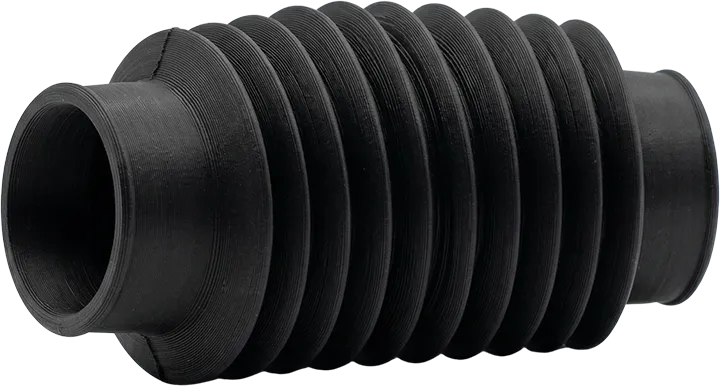
TPU-E Flexible Filament is a high-performance elastomer that combines the flexibility of rubber with the processability of thermoplastics. Parts produced with FDM 3D Printing technology stretch rather than break when bent and return to their original shape. Unlike standard plastics, it offers excellent vibration dampening and shock absorption properties. It is the ideal material for bellows, gaskets, and hoses in the automotive sector, as well as protective cases and wearable technology prototypes in consumer electronics. Its high abrasion resistance ensures longevity in parts subjected to friction.
Advantages
High Flexibility & Elasticity: Can stretch up to 500% without breaking and returns to its original shape without deformation.
Abrasion & Tear Resistance: Much higher resistance to friction than ABS or PLA; withstands harsh industrial conditions.
Chemical Resistance: Resistant to industrial oils, greases, and many solvents.
Vibration Dampening: Absorbs shocks, working effectively as a vibration isolator in machine mounts or drone frames.
Limitations
Printing Speed: Due to its flexible nature, it must be printed much slower than standard filaments, extending production time.
Support Removal: Layers bond very strongly, making it difficult to separate support structures from the main part; support usage should be minimized in design.
Post-Processing: Sanding or chemical smoothing is not possible due to its rubber-like texture.
Mechanical Properties
Metric Measurements
Elastic Modulus
[acf_group group=”mekanik_ozellikler” field=”elastisite_modulu”] GPa
Elongation at Break
[acf_group group=”mekanik_ozellikler” field=”kopma_uzamasi”] %
Density
[acf_group group=”mekanik_ozellikler” field=”yogunluk”] g/cm³
TPU-E Filament FAQ
What is the difference between TPU-E Filament and standard plastics?
The main difference is flexibility. While PLA or ABS are rigid, TPU-E Flexible Filament has a soft texture and behaves like rubber. This property allows TPU-E Filament to be used for sealing gaskets and flexible connectors.
What is the hardness (Shore value) of TPU-E Filament parts?
The TPU-E Flexible Filament we use is typically around 90A – 95A Shore hardness. This is similar to the tread of a car tire or a shopping cart wheel; it holds its shape but flexes under pressure.
Can gaskets be printed with TPU-E Filament?
Yes. TPU-E Flexible Filament has excellent layer adhesion. When printed with correct settings, it provides liquid and air tightness, making it ideal for gasket prototypes in Functional Prototyping.
Is it resistant to outdoor conditions and chemicals?
Yes. TPU-E Flexible Filament shows high resistance to ozone, low temperatures, and industrial oils. This makes it safe for use in exterior trim and engine bay components within the Automotive and Mobility sector.
How are support structures removed?
Since TPU-E Flexible Filament layers bond very tightly, removing supports is difficult and may leave marks. Therefore, we recommend optimizing your designs to avoid overhangs (keep angles below 45 degrees) where possible.
Is TPU-E Filament food safe?
While some TPU-E Flexible Filament grades are certified food-safe, the porous nature of FDM printing creates a risk of bacteria growth. Parts intended for food contact should be sealed with a specialized coating.
Quote in Seconds, Parts in Days
Upload your 3D CAD files, select your manufacturing technology, and receive an instant cost analysis. Zero wait time, no minimum order requirements.