


On-Demand Low-Volume Production
Through our On-Demand Low-Volume Production service, we accelerate your time-to-market by manufacturing 10 to 1,000 end-use parts without high mold investments.
Upload your CAD files and receive a custom quote within 2 hours.
Your uploads are confidential and secure.
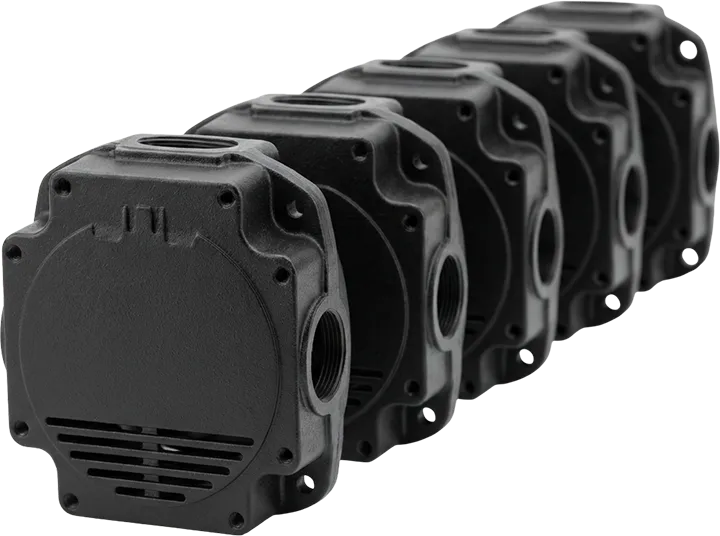
What is Low-Volume Production?
Low-Volume Production is a manufacturing strategy that bridges the gap between prototyping and mass production, typically covering needs ranging from 10 to 1,000 units.
At ProtoDep, depending on your quantity and material requirements, we utilize SLS 3D Printing Service for tool-less manufacturing, Vacuum Casting Service for polyurethane parts, or RIM Molding for large housing components. This service is the most efficient route for investor presentations, field testing (beta tests), and on-demand manufacturing.
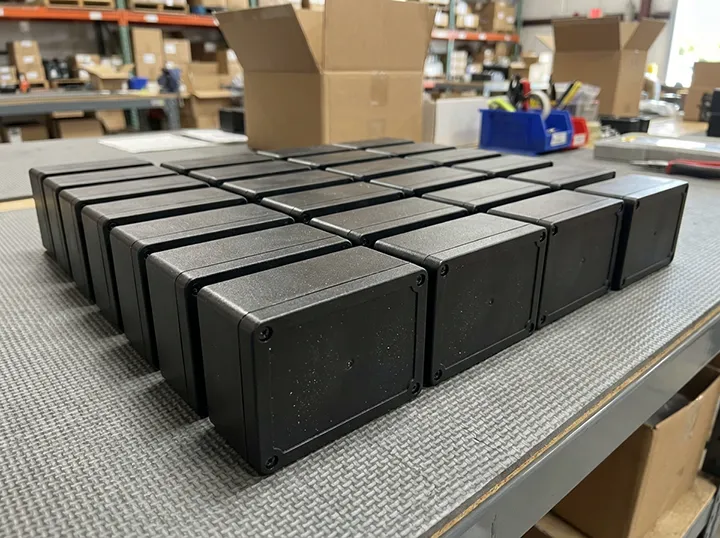
Low-Volume Advantages
Low Upfront Cost: Eliminates tens of thousands of dollars in steel tooling costs or uses cheaper (Aluminum/Silicone) molds.
Fast Time-to-Market: Get your product on shelves in weeks instead of waiting months for steel molds.
Design Flexibility: Allows for design iterations before committing to mass production.
Zero Inventory: Reduces storage costs and dead stock risk by producing only what you need.
Low-Volume Limitations
Unit Cost: Per-part cost is higher compared to injection molding producing millions of units.
Capacity Limit: Generally loses economic advantage for demands exceeding 1,000 – 2,000 units (Injection molding is preferred there).
Surface Finishing: Some technologies (e.g., SLS) require extra blasting or painting for a smooth finish.
Material Constraints: Not as wide a range as injection molding (though simulation materials are highly advanced).
Which Tech for Which Volume?
| Quantity Range | Recommended Technology | Description |
| 1 – 10 Units | Industrial 3D Printing | SLA or FDM for tool-less, direct, and fast production. |
| 10 – 50 Units | Vacuum Casting | Injection-quality production using PU Casting Resin (ABS-like). |
| 50 – 500 Units | SLS (Sintering) | Durable, support-free serial production with PA12 Nylon. |
| 100 – 1000+ Units | RIM / Rapid Tooling | RIM for large parts or rapid aluminum tooling for injection molding. |
Materials Used
Depending on the production technology, we manufacture mechanical parts with Nylon PA12 (Engineering), lenses with Optical Clear Casting Resin, or aerospace-grade components with Flame Retardant Resin.
Industries Relying on Low-Volume Production
Startups & Ventures
Producing the first batch of 100-200 units with an end-product look for Kickstarter campaigns or initial sales without tooling investment.

Medical and Healthcare Technologies
Limited production of certified and biocompatible devices required for clinical trials and validation.
Explore Industry
Automotive and Mobility
On-demand production of custom vehicle bumpers, console parts, or rare spare parts for classic cars.
Explore Industry
Industrial Machinery and Robotics
Re-manufacturing critical parts for discontinued machines by digitizing them via 3D Scanning & Reverse Engineering.
Explore IndustryLow-Volume FAQ
When should I choose low-volume production over traditional mass injection molding?
Low-volume production is the ideal choice when your annual requirement is under 5,000 units or when your product design is still evolving. It eliminates the high upfront cost of permanent steel tooling, protects your cash flow, and allows for much faster market entry compared to traditional manufacturing methods.
Are parts manufactured through low-volume production suitable for final end-use and retail?
Yes, parts produced via professional Vacuum Casting and RIM (Reaction Injection Molding) are of industrial grade and end-use quality. When combined with our professional surface finishing and painting services, these components are indistinguishable from mass-produced plastic parts and are fully suitable for commercial sale.
What is Bridge Tooling and how does it benefit the product launch process?
Bridge Tooling is an interim manufacturing strategy that fills the gap between prototyping and high-volume production. It utilizes rapid tooling technologies to produce functional parts immediately, allowing companies to launch their products and generate revenue while waiting for long-lead-time steel molds to be completed.
What is the typical lead time for batch manufacturing and low-volume production orders?
Lead times depend on the chosen technology and order volume. Batch 3D printing orders (SLS/FDM) are typically delivered within 3 to 5 business days. More complex projects involving Vacuum Casting or RIM molding generally have a turnaround time of 2 to 3 weeks, including mold creation and part production.
Are material properties the same as mass production?
Largely, yes. Materials like ABS-Like Technical Resin or PA12 Nylon match 90%-95% of the physical and chemical properties of thermoplastics.