


SLS 3D Printing
With Professional SLS 3D Printing, we sinter PA12 Nylon powders to manufacture durable, support-free complex geometries and moving mechanisms without assembly.
Upload your CAD files and receive a custom quote within 2 hours.
Your uploads are confidential and secure.
What is SLS 3D Printing?
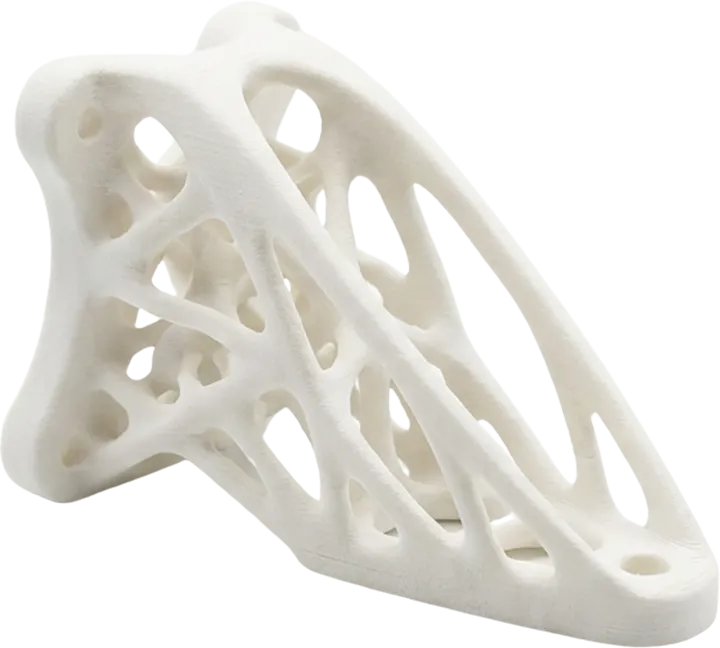
SLS (Selective Laser Sintering) operates by using a high-power laser to fuse small particles of polymer powder (typically Nylon) layer by layer with micron-level precision. The defining feature of this technology is that the part remains suspended in the unsintered powder bed during production, eliminating the need for support structures.
At ProtoDep, utilizing industrial-standard materials like Nylon PA12 (Engineering), we can produce interlocked moving parts and single-piece mechanisms that are impossible to make with FDM or SLA. It is the most efficient technology for low-volume production, effectively eliminating tooling costs.
SLS Printing Advantages
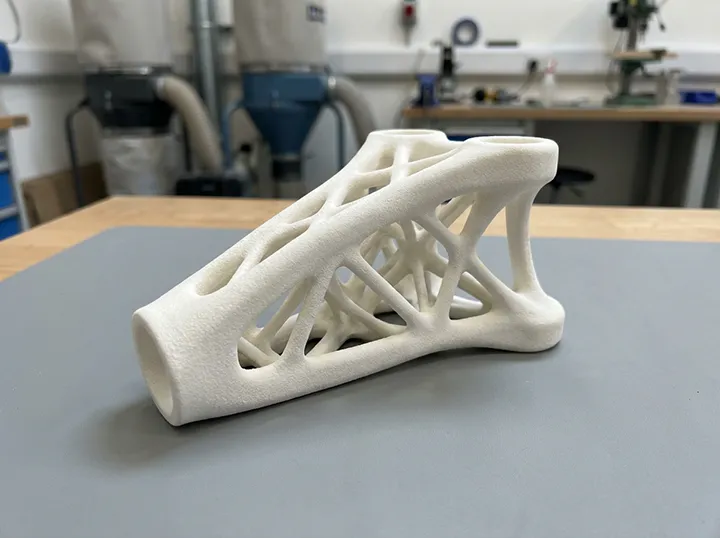
Support-Free: The powder bed supports the part, allowing for limitless geometric freedom and complex undercuts.
Isotropic Strength: Parts exhibit equal strength in all directions (X, Y, Z), offering durability comparable to injection molding.
Batch Production: Parts can be stacked (3D Nesting) within the build volume, enabling the production of hundreds of units in a single run.
Heat & Chemical Resistance: PA12 materials demonstrate superior resistance to high heat (up to 175°C) and chemicals.
SLS Printing Limitations
Surface Roughness: Parts have a “grainy” or matte texture; not as smooth as SLA (though can be improved).
Color Options: Standard parts are white or grey. Coloring is achieved through post-process dyeing.
Tolerance: Large, flat surfaces may be prone to slight warping during the cooling process.
Watertightness: Raw parts are microscopically porous; chemical sealing is required for liquid tightness.
SLS Production Specifications
Metrik Ölçüler
Maximum Build Volume
380 x 284 x 380 mm
Standard Tolerance
±0.2 mm
Layer Thickness
80 mikron
Min. Wall Thickness
0.8 mm
SLS Material Options
We offer Nylon PA12 (Engineering) for standard engineering applications and Carbon Fiber Reinforced Nylon for projects requiring higher stiffness and thermal resistance.
Nylon PA12 (Engineering)
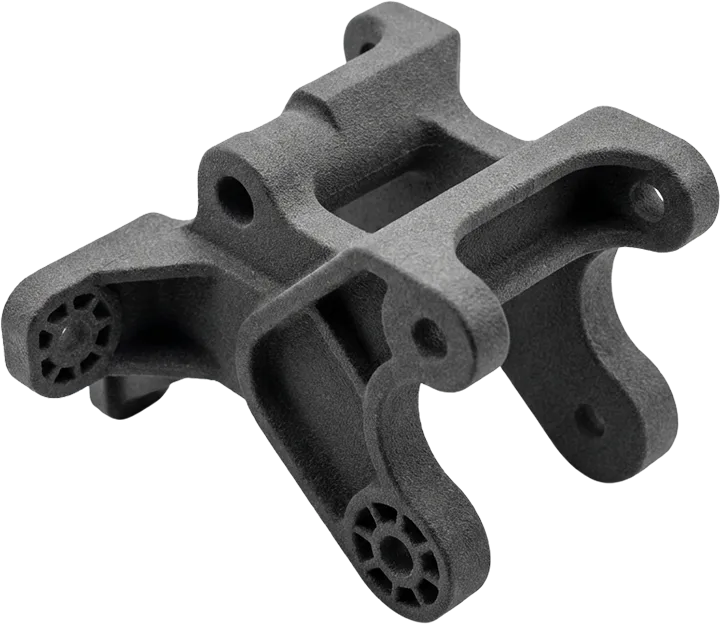
High-strength Polyamide 12 with a low friction coefficient and superior wear resistance for mechanical tools.
About Nylon PA12 (Engineering)Industries Using SLS Printing

Automotive and Mobility
The industry standard for high-heat resistant under-hood components, manifolds, fuel clips, and rigorous functional prototypes.
Explore Industry
Industrial Machinery and Robotics
Manufacturing of robotic grippers with complex internal air channels and living hinge machinery components that require no assembly.
Explore Industry
Medical and Healthcare Technologies
The preferred technology for patient-specific prosthetics and orthotics due to the skin-safe (biocompatible) nature of Nylon material.
Explore IndustrySLS 3D Printing Design Guide
Can complex moving mechanisms be printed fully assembled using SLS technology?
Yes, one of the primary advantages of Selective Laser Sintering (SLS) is the ability to produce ‘print-in-place’ mechanisms. Since SLS is a support-free 3D printing technology, complex assemblies such as interlocking chains, hinges, and gears can be manufactured fully assembled in a single production run.
How can I reduce SLS 3D printing costs through part design?
Hollowing out thick sections of a model is an effective way to reduce material volume and overall SLS printing costs. However, it is mandatory to include at least two escape holes (minimum 3-5mm) in the design to allow the removal of unsintered powder from the interior during post-processing.
What is the typical surface finish of raw SLS (Nylon PA12) parts?
Raw SLS parts emerge with a matte, grainy texture similar to fine-grit sandpaper. To achieve a smoother and more aesthetic finish, we provide professional post-processing services such as bead blasting, media tumbling, and chemical vapor smoothing to enhance the surface quality of PA12 components.
Are SLS 3D printed parts watertight and suitable for fluid-handling applications?
Standard SLS Nylon PA12 parts are slightly porous and may not be 100% leak-proof under high pressure. For applications requiring watertightness, such as tanks or manifolds, we apply specialized chemical impregnation or sealing processes to ensure the parts are fully airtight and leak-proof.
What is the recommended minimum wall thickness for industrial SLS 3D printing?
To ensure structural integrity and prevent thermal warping (warpage) during the laser sintering process, we recommend a minimum wall thickness of 1.0 mm to 1.2 mm. While features as thin as 0.8 mm can be printed, a 1.0 mm thickness is the industry standard for functional engineering parts.
Does warping occur in large parts?
Large flat surfaces may warp during cooling. To prevent this, we recommend adding “ribs” to your design or requesting that we orient the part at an angle.
What are the options for coloring and painting SLS Nylon parts?
Due to the porous structure of Nylon PA12, SLS parts are excellent candidates for immersion dyeing (dye bath), which allows the color to penetrate the surface for superior wear resistance. Additionally, parts can be finished with professional spray painting or automotive coatings for precise RAL or Pantone color matching.
Quote in Seconds, Parts in Days
Upload your 3D CAD files, select your manufacturing technology, and receive an instant cost analysis. Zero wait time, no minimum order requirements.